Can Parkinson’s Disease Be Smelled? A Breakthrough for Digital Olfaction
A remarkable story is showing how human olfaction can inspire the next generation of medical diagnostics.
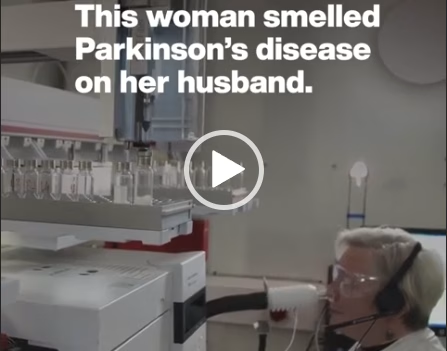
Joy Milne, a retired Scottish nurse, noticed a distinct change in her husband’s scent years before he was diagnosed with Parkinson’s disease. She later recognized the same odor in other patients, leading researchers at The University of Manchester to investigate whether Parkinson’s leaves a detectable chemical signature on the skin.
Their work focused on sebum, the oily substance naturally present on the skin. Using mass spectrometry, researchers developed a rapid skin-swab approach that can analyze Parkinson’s-related molecular signatures in around three minutes. The study compared samples from 79 people with Parkinson’s disease and 71 controls, identifying lipid changes that distinguish the two groups.
This research, published in JACS Au, builds on earlier peer-reviewed studies in ACS Central Science and Nature Communications, which showed that Parkinson’s disease is associated with measurable changes in skin chemistry and volatile biomarkers.
For the Digital Olfaction Society, this story is highly symbolic. It shows that disease odors are not anecdotal curiosities, but measurable biological signals that may become part of future non-invasive diagnostics.
The next challenge is clear:
Can digital olfaction transform invisible disease signatures into rapid, scalable diagnostic tools?
This question will be central to the discussions at Digital Olfaction 2026, where scientists, clinicians, engineers, and industry leaders will explore how olfactory technologies can move from detection to diagnosis.
Read the full news here
Read the news on LinkedIn
Video credit: World Economic Forum
Scientific source: The University of Manchester / JACS Au.