What Will Coffee Smell Like in 2126? Digital Olfaction Lets Us Experience the Future
From Brazil to Sierra Leone and Mars: An Interactive Experiment Explores How Climate Change Could Transform the Coffee We Drink
Can we smell the future of coffee before it arrives? At the Digital Olfaction Society World Congress 2026 in Tokyo, artist and designer Sarah Ali will introduce Brew_Lab, an interactive experience that combines scent technology, climate research and sensory perception to explore possible futures of coffee.
Climate Change Is Transforming Coffee. What Will It Taste Like?
Coffee is more than a beverage. Its aroma is deeply connected to our memories, habits and everyday experiences.
But climate change is altering the environmental conditions under which coffee is grown. Rising temperatures, drought and shifting agricultural regions could influence which coffee species are cultivated and how their flavours develop.
Scientific projections usually communicate these transformations through charts, numbers and climate models.
What if we could experience these possible futures through our sense of smell?
This is the question behind Brew_Lab, an interactive olfactory installation developed by Sarah Ali, an independent artist and designer based in London, with a background in Material Futures at Central Saint Martins, University of the Arts London.
Three Futures. Three Aromas. One Cup of Coffee.
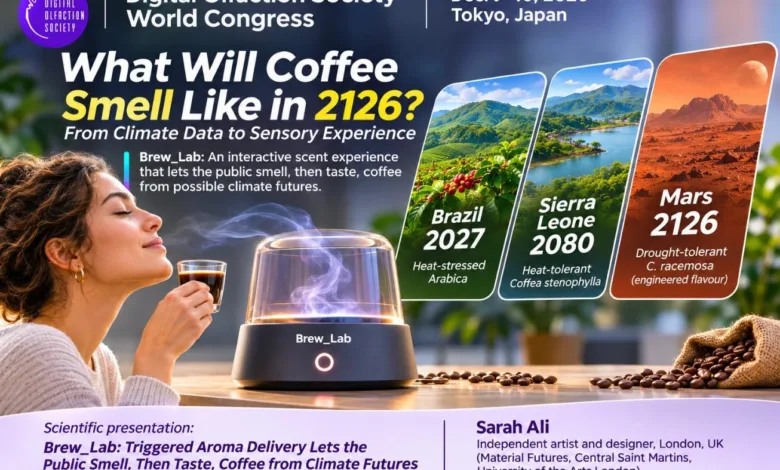
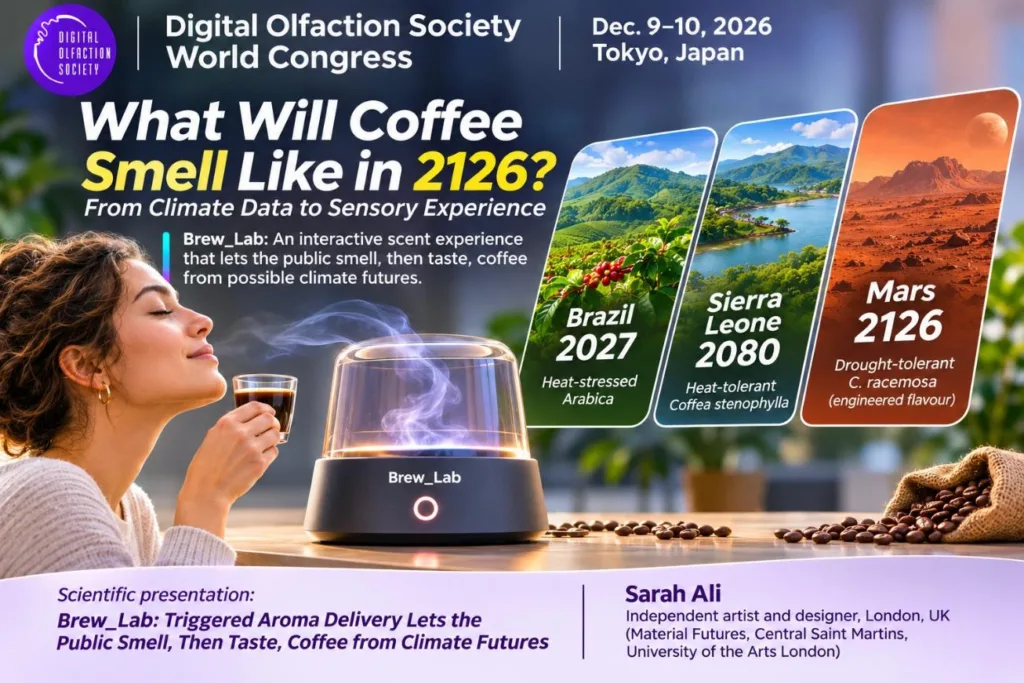
Brew_Lab invites visitors to explore three speculative coffee futures:
- Brazil, 2027: Arabica coffee facing heat stress.
- Sierra Leone, 2080: A future involving the heat-tolerant coffee species Coffea stenophylla.
- Mars, 2126: An imagined scenario featuring drought-tolerant Coffea racemosa and engineered flavour.
Visitors select a scenario using an interactive device. The system releases a corresponding food-grade aroma developed in collaboration with the scent studio Scentible.
Participants smell the aroma before tasting the same base coffee.
The experiment explores a fascinating interaction between olfaction, flavour perception and expectations.
Can Changing the Aroma Change the Taste?
At Milan Design Week 2026, approximately 800 visitors experienced Brew_Lab.
According to preliminary, informal visitor feedback:
- Around 80% reported that the coffee tasted different after smelling the aroma.
- Around 30% selected a coffee based on the smell associated with its future environment.
These observations are not controlled experimental results. However, they suggest that scent-based interfaces may offer an engaging way to communicate complex environmental scenarios.
From Climate Data to Sensory Experience
Brew_Lab brings together climate and coffee research, scientist interviews, NASA data and interactive aroma delivery.
Rather than simply showing what climate change might mean for agriculture, the installation invites people to experience a sensory interpretation of possible futures.
Future research will aim to measure changes in perceived flavour systematically and explore how aroma formulations might be connected to live environmental data.
Could Digital Smell Change How We Communicate Science?
Brew_Lab illustrates an emerging direction for digital olfaction: transforming abstract scientific information into direct sensory experiences.
The broader question extends beyond coffee.
Could scent technology help people better understand environmental change, future food systems and the relationship between our senses and the world around us?
Sarah Ali’s work offers an original perspective on how olfactory interfaces might connect scientific research, design and public engagement.
Discover Brew_Lab at Digital Olfaction 2026
Presentation: Brew_Lab: Triggered Aroma Delivery Lets the Public Smell, Then Taste, Coffee from Climate Futures
Presenter: Sarah Ali
Independent Artist and Designer, London, United Kingdom
Digital Olfaction Society World Congress 2026
December 9–10, 2026 | Tokyo, Japan
Submit a demonstration here
For more information:
Read the news on LinkedIn