What If Artificial Intelligence Could Understand and Explain What It Smells?
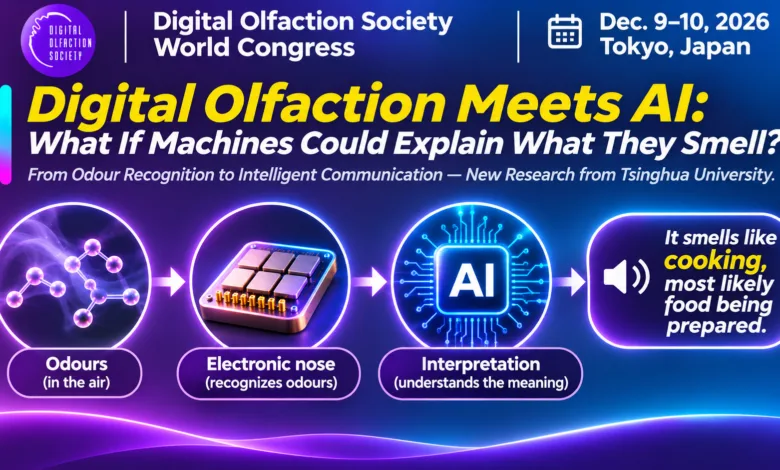
Beyond Odour Detection: Scientists at Tsinghua University Combine Digital Olfaction and AI to Develop Machines That Recognize Smells and Communicate Their Meaning
Imagine a future in which your home could recognize an unfamiliar smell, interpret its possible significance and explain what is happening. Researchers at Tsinghua University are exploring how electronic noses and artificial intelligence could bring this capability closer to reality.
From Detecting Odours to Understanding Their Meaning
Artificial intelligence has transformed how machines see, hear and communicate. Computer vision can recognize objects, speech recognition can interpret conversations, and large language models can generate detailed explanations. But one important human sense remains comparatively underdeveloped in intelligent machines: smell.
Electronic noses have already demonstrated their usefulness in food quality assessment, industrial safety and environmental monitoring. However, many existing systems are developed to identify specific substances or perform narrowly defined tasks.
Everyday environments are far more complex. A home, hospital or workplace contains constantly changing mixtures of odours, and identifying a chemical signal is not necessarily enough to understand its relevance.
Could machines move beyond recognizing odours and begin explaining what those odours might mean?
This is the question explored by researchers from The Future Laboratory and the Academy of Arts & Design at Tsinghua University, China, whose work will be presented at the Digital Olfaction Society World Congress 2026, taking place in Tokyo on December 9–10.
Giving Artificial Intelligence a Sense of Smell
The research, entitled “Designing Electronic Noses for Universal Odor Recognition and Contextual Interaction,” was conducted by Yu Gang, Sun Yuchi, Lu Qi, Yang Jiawei and Xu Yingqing.
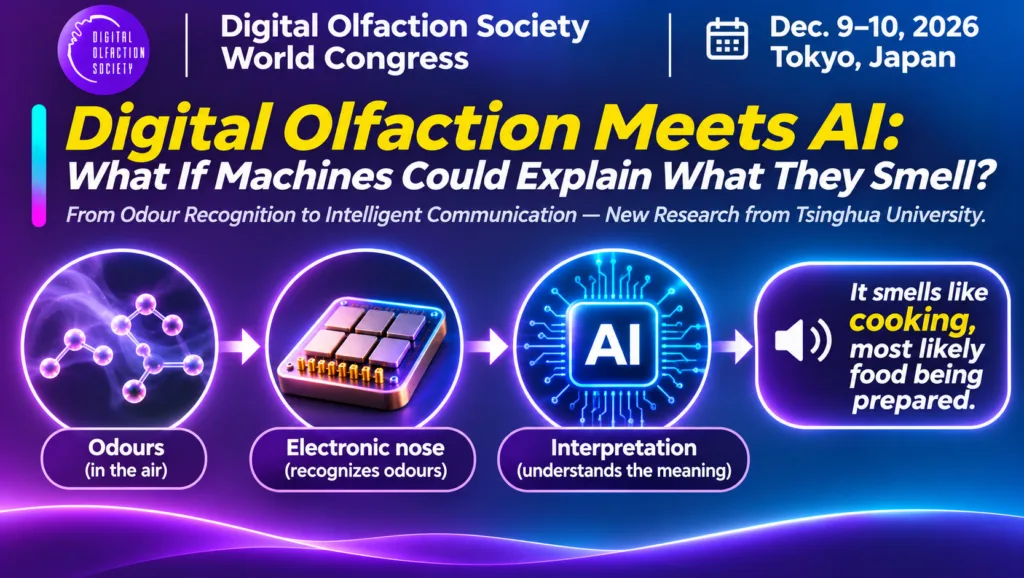
The team developed a machine-olfaction framework integrating an eight-channel metal-oxide semiconductor sensor array, machine-learning classification and an AI-based interpretation system.
The electronic nose collects chemical response patterns from different odour sources, creating what researchers describe as olfactory fingerprints. Machine-learning algorithms then classify these patterns.
But the researchers went further.
They connected the sensing system to a large language model capable of generating contextualized voice feedback, transforming a sensor classification into information intended to be understandable and useful to people.
The ambition is to make digital olfaction more than a detection technology: a sensory interface that can support human decision-making.
From 53 Odour Sources to Real-Time Recognition
To evaluate the technical framework, the researchers collected sensor responses from 53 odour sources and tested the system across multiple days.
In real-time embedded tests involving 24 merged odour classes, the classification system achieved an average accuracy of 82.1%.
This represents a promising experimental result, although it does not establish universal recognition of arbitrary smells or reliable performance in all real-world environments.
The researchers also conducted a user study involving 32 participants, evaluating contextualized voice responses for four household odours.
Questionnaires and interviews explored how participants perceived the system’s explanations, including their clarity, credibility, practical value and potential influence on behaviour.
This human-centred evaluation is important because a machine that recognizes an odour is not necessarily a machine that people can understand or trust.
What Could an AI-Powered Electronic Nose Do in Our Homes?
Imagine an intelligent home system that detects an unusual odour and provides an understandable explanation rather than displaying an unfamiliar sensor reading.
Or a future household robot that can recognize different odour patterns and communicate relevant observations to its user.
Such applications could connect digital olfaction with smart-home technologies, personal assistance and embodied robotics.
However, these remain potential applications. Further research will be needed to establish the accuracy, reliability and safety of such systems in complex everyday environments.
An important challenge will be ensuring that AI-generated explanations remain grounded in what the sensors have actually detected, rather than suggesting a level of certainty that the measurements cannot support.
A New Direction for Digital Olfaction
The broader significance of this research lies in the combination of three capabilities: chemical sensing, intelligent interpretation and human interaction.
Traditionally, electronic noses have been evaluated primarily by their ability to distinguish chemical patterns or classify particular odours.
The Tsinghua University approach adds another question: once a machine detects a smell, how should it communicate that information to a person?
This shift could become increasingly relevant as sensing technologies are integrated into everyday objects and autonomous systems.
The future of digital olfaction may not simply involve machines that smell more accurately, but machines that can transform chemical information into meaningful, context-aware communication.
The research presented at DOS 2026 offers an experimental step toward that vision, while highlighting the importance of combining sensor performance with human-centred design.
From Artificial Intelligence to Artificial Olfaction
As intelligent technologies acquire increasingly sophisticated capabilities, the ability to sense and interpret chemical information could become an important dimension of human–machine interaction.
The work from Tsinghua University suggests that integrating electronic noses with AI reasoning systems could help bridge the gap between detecting an odour and communicating its possible significance.
We have taught machines to see, hear and speak. Could digital olfaction become the next step in how machines perceive and interact with our world?
This question will be explored at the Digital Olfaction Society World Congress 2026 in Tokyo.
Scientific presentation: Designing Electronic Noses for Universal Odor Recognition and Contextual Interaction
Authors: Yu Gang, Sun Yuchi, Lu Qi, Yang Jiawei and Xu Yingqing
Institutions: The Future Laboratory and Academy of Arts & Design, Tsinghua University, China
Digital Olfaction Society World Congress 2026
December 9–10, 2026 | Tokyo, Japan
Discover the scientific programme:
https://digital-olfaction.com/
Submit a demonstration here