
What If the Future of Digital Olfaction Lies in the Human Nose?
Inspired by Nature: Scientists Explore How Moisture Could Transform Electronic Smell Detection
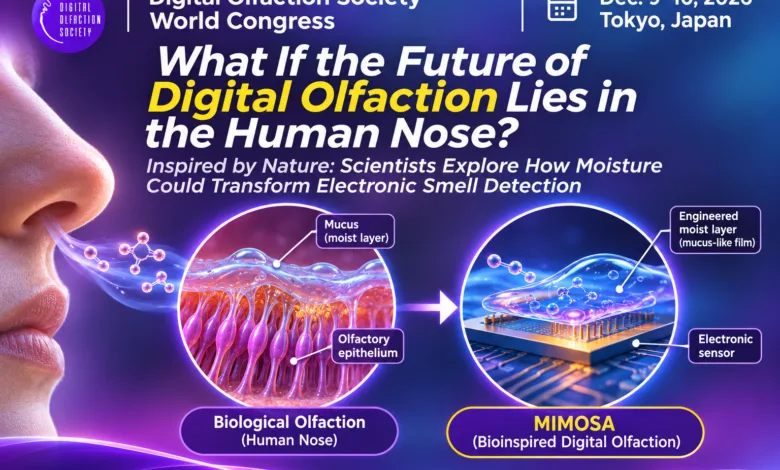
The human nose has evolved a remarkable ability to detect and distinguish an enormous diversity of airborne molecules. Yet reproducing this biological capability remains one of the major challenges in digital olfaction. While artificial intelligence can recognize faces, interpret speech and process vast amounts of information, electronic noses still face difficulties in capturing, retaining and distinguishing volatile organic compounds (VOCs), particularly when environmental humidity changes.
Could the solution to better digital smell detection lie in one of the most fundamental characteristics of our own olfactory system?
At the Digital Olfaction Society World Congress 2026, taking place in Tokyo on December 9–10, researchers Lawrence Nsubuga and Roana de Oliveira Hansen from the Mads Clausen Institute, University of Southern Denmark, will introduce a bioinspired approach that could help address these limitations. Their research, entitled “MIMOSA: A Moisture-Inspired Molecular Sensing Architecture for Enhanced Digital Olfaction,” explores how mimicking the moisture-rich environment of the human nose could improve the way electronic sensors interact with odorant molecules.
In biological olfaction, airborne molecules encounter a hydrated, mucus-covered surface before interacting with sensory receptors. This moist layer plays an important role in dissolving and transporting odorants. Rather than treating moisture simply as an environmental disturbance, the researchers propose using it as a functional component of artificial smell detection.
The concept, called MIMOSA (Moisture-Inspired Molecular Sensing Architecture), introduces engineered mucus-like liquid films between airborne odorants and electronic sensing surfaces. These films are designed to capture, retain and transport molecules, potentially improving the quality and stability of the chemical information reaching the sensor.
The proposed materials include glycerol-based matrices, ionic liquids and deep eutectic solvents. Their chemical and physical properties could be adjusted to interact with different classes of volatile compounds. By modifying characteristics such as viscosity, molecular affinity and hydrophilicity, researchers hope to create more selective and stable sensing interfaces.
One particularly interesting aspect of this approach is that it does not necessarily require an entirely new electronic sensor. Instead, MIMOSA focuses on improving the interface between the surrounding chemical environment and existing sensing technologies. The architecture is intended to be compatible with metal-oxide, electrochemical, resonant, acoustic and conductive polymer sensors.
The concept builds on earlier work involving engineered binder formulations that demonstrated enhanced sensitivity in specific gas-sensing applications, including the detection of biogenic amines. However, MIMOSA remains a proposed sensing architecture, and its anticipated performance advantages still require experimental validation in integrated electronic-nose systems.
If successful, this approach could have implications for several emerging applications of digital olfaction. In healthcare, improved molecular sensing could support research into detecting disease-associated volatile compounds. In environmental monitoring, more stable sensors might help characterize complex chemical emissions. Food-quality assessment, industrial safety and intelligent sensing systems could also benefit from advances in chemical selectivity and measurement reliability.
Beyond these potential applications, MIMOSA raises a broader question about the future of artificial olfaction. Much of the technological progress in this field has focused on electronic components, sensor arrays and increasingly sophisticated data-analysis algorithms. But biological systems suggest that the way odorant molecules are captured and delivered to a sensing surface may be just as important as the sensor itself.
What if the next major advance in digital olfaction comes not from making electronic systems more complex, but from making their sensing interfaces more like those found in nature?
The research presented by Nsubuga and de Oliveira Hansen highlights how materials science, biomimetics and digital olfaction can converge to explore new approaches to chemical sensing. By translating the biological principles of the olfactory mucosa into engineered interfaces, MIMOSA proposes a path toward potentially more sensitive, selective and environmentally robust electronic noses.
The next scientific challenge will be to establish how effectively these moisture-inspired interfaces perform under realistic conditions, determine their compatibility with different sensor technologies and demonstrate whether they deliver consistent improvements over conventional sensing surfaces.
As digital olfaction expands toward healthcare, environmental monitoring and intelligent technologies, understanding how biological systems process chemical information may become increasingly important.
Nature has developed sophisticated mechanisms for detecting smells. Could learning from the human nose help us design the next generation of digital olfaction technologies?
This question will be explored at the Digital Olfaction Society World Congress 2026, taking place in Tokyo, Japan, on December 9–10.
The scientific poster “MIMOSA: A Moisture-Inspired Molecular Sensing Architecture for Enhanced Digital Olfaction” is authored by Lawrence Nsubuga and Roana de Oliveira Hansen, Mads Clausen Institute, University of Southern Denmark.
Discover the programme and the latest developments in digital olfaction at https://digital-olfaction.com/.
Submit a demonstration here