Can You Smell a Virtual World? Digital Olfaction Brings Coffee, Fresh Bread and Apple Pie into VR


Beyond Sight and Sound: Brazilian Researchers Explore How Synchronized Scents Could Make Virtual Reality More Immersive
Imagine entering a café, approaching the counter and smelling freshly brewed coffee. Nearby, the aroma of warm bread fills the air, while the scent of apple pie adds another familiar sensation. Everything seems natural, except for one detail: the café does not exist. You are wearing a virtual reality headset, and the smells are being generated by a digital olfactory system.
Virtual reality has made remarkable progress in recreating what we see and hear. From immersive games to professional training and virtual tourism, digital environments are becoming increasingly realistic. Yet something essential is still missing from most experiences: our sense of smell. The aroma of coffee, the fragrance of flowers or the smell of freshly baked food can instantly change how we perceive a place. Without these sensory cues, even the most visually convincing virtual environment may feel incomplete.
Could digital olfaction help bridge this gap?
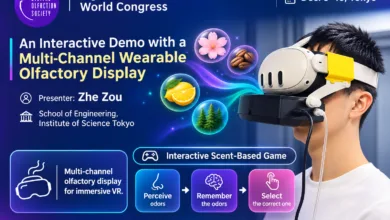
At the Digital Olfaction Society World Congress 2026, taking place in Tokyo on December 9–10, researchers from the Advanced Knowledge Center for Immersive Technologies (AKCIT), Brazil, will present an experimental system that brings scent into virtual reality in a particularly interesting way.
Their research, entitled “Synchronized Digital Scent Delivery in VR: A Multichannel Ultrasonic Olfactory Display Evaluated in a Virtual Cafeteria Scenario,” explores how smells can be released at the right moment, depending on where a person is looking and how they move through a virtual environment.
Led by Pedro K. Diniz and colleagues, the team created an interactive virtual cafeteria using Unreal Engine and a Meta Quest 3 headset. They integrated a three-channel ultrasonic scent-delivery device capable of releasing the aromas of coffee, bread and apple pie. Unlike systems that simply diffuse fragrance continuously, this technology links each scent to a corresponding virtual object.
When a participant approaches an object or turns toward it, the system uses proximity and head orientation to determine when the associated aroma should be delivered. The idea is to make smell feel like a natural part of the virtual scene rather than an isolated sensory effect.
To investigate whether this approach changes the experience, the researchers invited 11 participants affiliated with their laboratory to explore the virtual cafeteria under two conditions: one with synchronized odours and another without scent. They compared participants’ sense of presence, emotional responses, usability, acceptance, simulator sickness and heart rate.
The results suggest that adding smell may enhance the virtual experience. The average presence score increased from 4.90 without scent to 5.40 with scent, with nine of the eleven participants reporting a stronger sense of presence when odours were included. However, the difference did not reach conventional statistical significance, meaning that larger studies are needed before drawing firm conclusions.
The researchers also observed changes in emotional responses. Average positive valence increased from 6.73 to 7.73, while reported arousal decreased. Participants rated the usability of the system at 83.6 out of 100, suggesting that the scent-delivery interface was generally well received.
What makes these findings particularly interesting is the effort to integrate smell into an ordinary, recognizable situation. Rather than asking participants to identify isolated fragrances in a laboratory, the researchers recreated a familiar social environment where odours naturally belong.
A café is an ideal example. Coffee, bread and pastries are not simply objects we recognize visually. Their aromas contribute to how we experience the environment, often triggering expectations, memories and emotional associations.
The work addresses one of the persistent challenges in digital olfaction: delivering an appropriate odour at precisely the right time. While technologies for detecting and analysing smells have advanced considerably, reproducing them convincingly during interactive experiences remains difficult.
The ability to synchronize scents with virtual objects could eventually have implications beyond entertainment. Researchers may explore applications in immersive education, virtual tourism, professional training and multisensory simulations. However, these possibilities remain prospective, and the present study involved only a small group of laboratory-affiliated participants.
The Brazilian team plans a larger controlled study involving participants outside the laboratory to better understand whether synchronized scent delivery consistently improves immersion and user experience.
Nevertheless, their work illustrates an important shift in digital olfaction. The ambition is no longer simply to generate a smell, but to make that smell appear naturally within a digital environment, at the moment when a person expects to encounter it.
Perhaps the next generation of virtual reality will not be defined only by what we see and hear, but also by what we can smell.
The smell of coffee in a virtual café may seem like a small detail, but it raises a much larger question: how realistic could digital worlds become when they engage more of our senses?
This research will be presented at the Digital Olfaction Society World Congress 2026, bringing together scientists and technology developers exploring the future of artificial olfaction, scent delivery and human–machine interaction.
Scientific presentation: Synchronized Digital Scent Delivery in VR: A Multichannel Ultrasonic Olfactory Display Evaluated in a Virtual Cafeteria Scenario
Presenting researcher: Pedro K. Diniz, with colleagues from the Advanced Knowledge Center for Immersive Technologies (AKCIT), Brazil.
Digital Olfaction Society World Congress 2026
December 9–10, 2026 | Tokyo, Japan
Discover the scientific programme and emerging developments in digital olfaction:
https://digital-olfaction.com/
Submit a demonstration here