
What If We Could Map the Smell of a City?
From Invisible Odours to Digital Maps: Researchers Explore How Electronic Noses Could Reveal the Olfactory Identity of Our Surroundings
Every city has its own smell. From coffee shops and green spaces to busy streets and industrial areas, odours shape how we experience our environment. Yet, unlike noise, temperature or air quality, the spatial distribution of smells remains difficult to capture and visualize.
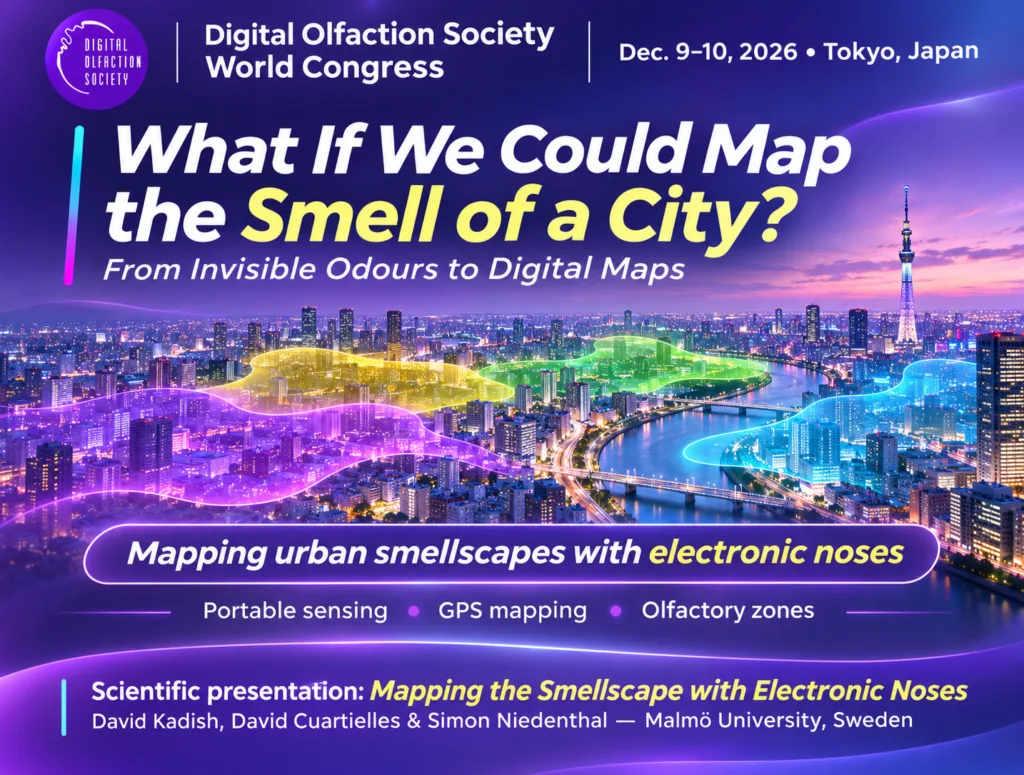
At the Digital Olfaction Society World Congress 2026, taking place in Tokyo on December 9–10, researchers from Malmö University, Sweden, will present an innovative approach to mapping the invisible world of smells.
Their study, “Mapping the Smellscape with Electronic Noses,” explores how portable electronic noses, GPS technology and digital mapping can work together to identify distinct olfactory zones in real environments.
Every Place Has a Smell. Can Technology Capture It?
We recognize places not only through what we see and hear, but also through what we smell.
The aroma of freshly brewed coffee, the scent of vegetation after rainfall or the distinctive odours of an urban street can all contribute to our perception of a location.
Scientists refer to this spatial distribution of odours as a smellscape.
But while we can easily create maps of streets, sound levels or temperature, mapping smells presents a more complex challenge.
What if we could transform these invisible olfactory patterns into a digital map?
This is the question addressed by David Kadish, David Cuartielles and Simon Niedenthal from Malmö University.
Turning a Walk into an Olfactory Map
The researchers developed a connected system combining a low-cost electronic nose with a mobile application.
The device incorporates 11 MEMS metal-oxide sensors, together with a BME680 environmental sensor, to collect measurements during outdoor walks.
As participants move through different locations, the system associates sensor readings with GPS coordinates.
A hierarchical clustering algorithm then groups similar sensor patterns, generating a map of distinct olfactory zones and their spatial boundaries.
The result is an emerging digital representation of how the olfactory environment changes from one place to another.
Can Electronic Noses Detect What Humans Smell?
One of the study’s most interesting findings concerns the relationship between electronic sensor measurements and human perception.
The researchers observed that several electronically identified olfactory zones overlapped with the scents perceived by people during their walks.
Some transitions between sensor-defined zones also corresponded to changes detected by the human nose.
However, other boundaries did not match human impressions as closely, highlighting the need for improved sensing and further validation.
The technology does not yet reproduce human olfactory perception, but it offers a promising way to document patterns that are otherwise difficult to visualize.
From Smellwalks to Smarter Environmental Design
The research raises possibilities for future applications of digital olfaction.
Could electronic noses eventually help urban designers better understand the sensory character of neighbourhoods?
Could smellscape maps contribute to environmental monitoring, architectural design or the study of how people experience public spaces?
These remain potential future directions rather than demonstrated applications of the current system.
Nevertheless, the work introduces an interesting approach to connecting chemical sensing, geographic information and human sensory experience.
Making the Invisible Environment Visible
Digital olfaction is often associated with identifying individual odours or reproducing scents through technological devices.
This research explores another dimension: understanding how smells are distributed across the spaces we inhabit.
By combining wearable sensing, mobile technology and computational analysis, the Malmö University team offers an early step toward mapping the olfactory characteristics of real-world environments.
Could smell become a new layer of the digital maps we use every day?
That is one of the questions to be explored at Digital Olfaction 2026 in Tokyo.
Meet the Researchers at Digital Olfaction 2026
Scientific presentation: Mapping the Smellscape with Electronic Noses
Authors: David Kadish, David Cuartielles and Simon Niedenthal
Institution: Malmö University, Sweden
Digital Olfaction Society World Congress 2026
December 9–10, 2026 | Tokyo, Japan
Discover how researchers are bringing the invisible world of smell into the digital age.
Submit a demonstration here
For more information:
Read the news on LinkedIn