
Can Electronic Noses Detect Wildfires Before Flames Appear?
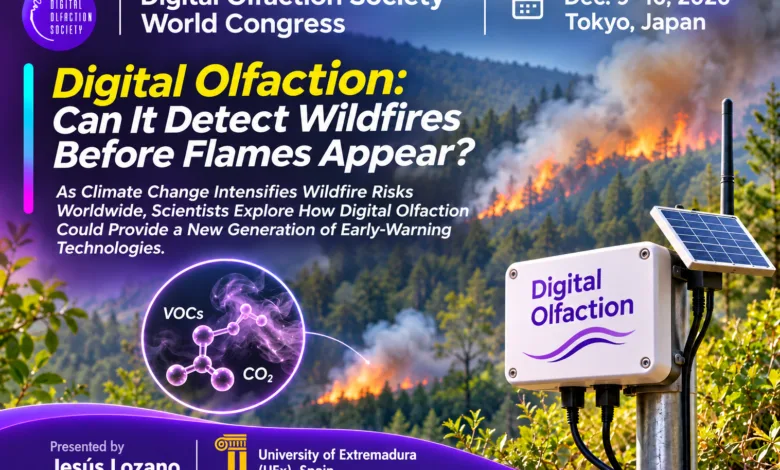
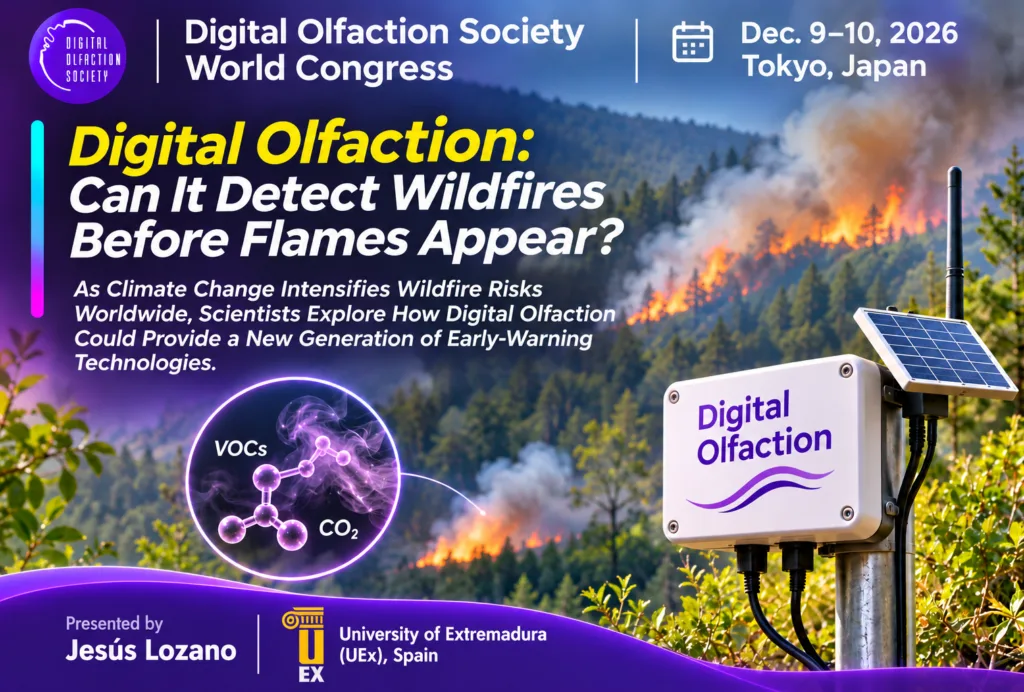
As Climate Change Intensifies Wildfire Risks Worldwide, Scientists Explore How Digital Olfaction Could Provide a New Generation of Early-Warning Technologies
From Southern Europe to North America and Australia, rising temperatures, prolonged droughts and extreme fire weather are placing forests and communities under growing pressure. Researchers in Spain are investigating whether affordable electronic noses could detect the earliest chemical signatures of combustion, potentially offering a valuable new tool in the fight against wildfires.
Wildfires: A Growing Global Environmental Challenge
Wildfires are among the most serious environmental threats facing many regions of the world.
In recent decades, rising global temperatures, prolonged periods of drought and increasingly extreme heatwaves have created conditions that favour the ignition and spread of fires in numerous regions.
The consequences can be devastating: destruction of forests, loss of biodiversity, damage to communities, deterioration of air quality and significant economic costs.
The scale of the problem is becoming increasingly evident.
According to the European Commission’s Joint Research Centre, 2025 was the most destructive wildfire season recorded in the European Union, with more than one million hectares burned.
In 2026, approximately 704,000 hectares had already burned across the EU by November 4, exceeding the long-term average for that point in the year.
Climate change is not responsible for every wildfire, but it is increasing dangerous fire-weather conditions in many regions, making prevention, monitoring and rapid detection increasingly important.
As wildfire risks grow, one question is becoming urgent: Can we detect a fire before it becomes visible?
Detecting Fire Through Its Chemical Signature
Traditional wildfire detection relies heavily on visual observations, cameras, satellites, thermal sensors and smoke detection.
These technologies are essential, but early detection can remain challenging, particularly in remote forests, densely vegetated areas and locations where monitoring infrastructure is limited.
Yet combustion can release gases before visible flames appear.
Among these chemical signals are carbon dioxide and volatile organic compounds (VOCs), which may provide an early indication of burning vegetation.
What if electronic noses could detect these invisible chemical changes and identify combustion at an earlier stage?
This possibility is being explored by researchers from the University of Extremadura and the INIA-CSIC Institute of Forest Sciences in Spain.
Their research will be presented at the Digital Olfaction Society World Congress 2026, taking place in Tokyo on December 9–10.
A Low-Cost Electronic Nose Designed to Detect Combustion
The study, entitled “Autonomous Detection of Biomass Combustion in a Wind Tunnel with a Low-Cost Electronic Nose,” investigates whether relatively inexpensive gas sensors can distinguish combustion events from normal environmental variations.
The research team, led by Jesús Lozano developed an electronic nose combining commercial metal-oxide gas sensors and non-dispersive infrared sensors integrated into custom low-power electronics.
Rather than relying on expensive or complex analytical instruments, the researchers explored whether accessible sensing components could offer a practical foundation for future autonomous fire-detection systems.
Testing the Technology Under Outdoor Conditions
Two electronic noses were positioned approximately 14 metres from a combustion area in a wind-tunnel installation.
The devices operated continuously for 24 days, without prior notification of when combustion experiments would occur.
During this period, researchers performed four controlled burns involving approximately 500 grams of biomass, with different moisture conditions.
The electronic noses continuously monitored changes in gaseous emissions.
Researchers then analysed the sensor signals over time and used principal component analysis to investigate whether combustion periods could be distinguished from background environmental variations.
Promising Results: Identifying Combustion from Sensor Signals
The results revealed clear changes in sensor responses during the controlled combustion experiments.
The researchers observed sustained deviations from baseline measurements that differed from ordinary daily fluctuations and slower sensor drift.
Principal component analysis distinguished fire and non-fire periods in the experimental dataset, although some overlap remained at lower signal amplitudes.
The first principal component accounted for 98.6% of the measured variance, indicating that much of the sensor response was shared across channels.
Importantly, this percentage describes the variance explained by the statistical model. It does not represent a 98.6% fire-detection accuracy.
The findings suggest that relatively simple metal-oxide sensor signals contain useful information for identifying biomass combustion.
However, environmental VOC variability remains a significant challenge.
Further research will need to evaluate adaptive detection thresholds, machine-learning methods and performance under more complex open-field conditions.
The technology has demonstrated the ability to identify controlled combustion events, but reliable early wildfire detection in natural forests has not yet been established.
Could Electronic Noses Become Part of Future Forest Protection Systems?
The potential importance of this research extends beyond the laboratory and experimental wind tunnel.
If validated under real forest conditions, inexpensive autonomous electronic noses could potentially complement existing wildfire-monitoring infrastructure.
Future applications might include distributed sensor networks in vulnerable forest regions, monitoring around critical infrastructure or additional detection capabilities in locations with limited camera coverage.
Combining chemical sensing with wireless communications and intelligent data processing could also provide opportunities for more responsive environmental-monitoring systems.
However, several important questions remain.
How reliably could the devices distinguish early combustion from normal forest VOC emissions?
How would wind, humidity, temperature and vegetation influence their performance?
Could they operate autonomously for extended periods while minimizing false alarms?
Addressing these challenges will be essential before practical deployment becomes possible.
Digital Olfaction Beyond Human Smell: Protecting Our Environment
Digital olfaction is often associated with artificial smell recognition, food quality, healthcare or immersive technologies.
But its potential applications extend much further.
The ability to detect chemical signatures in the environment could contribute to new approaches in environmental monitoring, industrial safety and natural hazard detection.
The research presented by Jesús Lozano and colleagues illustrates how electronic noses might eventually contribute to wildfire prevention strategies.
As global temperatures rise and many regions face increasingly dangerous fire-weather conditions, the need for affordable, reliable and scalable early-warning technologies is becoming more urgent.
Could the next generation of wildfire-detection systems recognize the chemical signature of a fire before anyone sees the flames?
This is one of the questions being explored at Digital Olfaction 2026.
Discover the Research at Digital Olfaction 2026
Scientific presentation:
Autonomous Detection of Biomass Combustion in a Wind Tunnel with a Low-Cost Electronic Nose
Authors: Jesús Lozano (President, Digital Olfaction Society 2026), Cristina Brugera, Patricia Arroyo, Jose Manuel Perea, Mercedes Guijarro and Javier Madrigal.
Institutions: University of Extremadura and INIA-CSIC Institute of Forest Sciences, Spain.
Project: SenForFire, supported by the Interreg VI-B Sudoe Programme and co-funded by the European Regional Development Fund.
Digital Olfaction Society World Congress 2026
December 9–10, 2026
Tokyo, Japan
Discover how digital olfaction is expanding beyond conventional applications to address important environmental and technological challenges.
https://digital-olfaction.com/
Submit a demonstration here
For more information:
Read the news on LinkedIn