
Can Two Smells Be Equally Pleasant but Make Us Feel Completely Different?
Beyond Pleasantness: Researchers Explore How Odours Influence Our Emotions and Bodily Sensations
Why does the smell of freshly brewed coffee make some people feel comforted, while another equally pleasant fragrance creates a completely different emotional response? Why can certain smells bring a sense of calm, while others make us feel more alert or uneasy? We know that smell is closely connected to our emotions and memories, but understanding exactly how odours influence what we feel remains an important scientific challenge.
Most studies of smell perception focus on two familiar questions: how pleasant is an odour, and how strong is it? These measurements are useful, but they may not fully explain our emotional reactions. Two fragrances can receive similar pleasantness ratings and be perceived at the same intensity, yet still evoke different experiences. This suggests that other characteristics of smell may play an important role in shaping our emotional and physical responses.
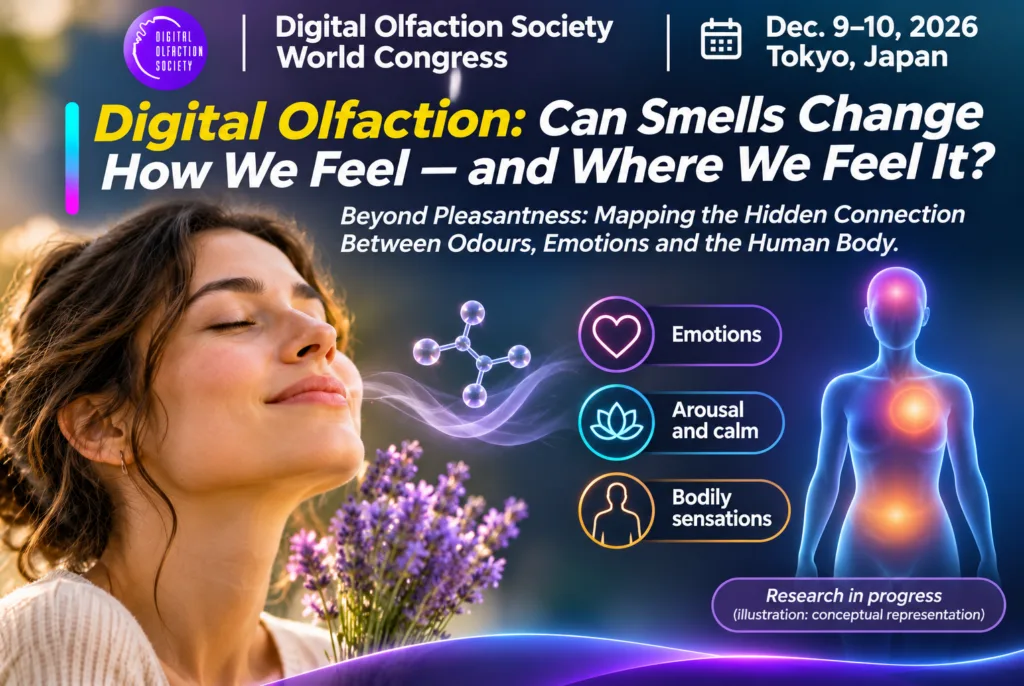
At the Digital Olfaction Society World Congress 2026, taking place in Tokyo on December 9–10, researchers will explore this question in a study entitled “Beyond Pleasantness and Intensity: Mapping Odour Quality onto Affective and Somatosensory State.”
The work brings together Hildelith Leyser from McGill University, Canada, Keith Patarroyo from the University of Glasgow, United Kingdom, and Robert Rauschen, an independent researcher based in Germany. Their objective is to better understand whether the specific qualities of an odour can influence emotions and bodily sensations independently of how pleasant or intense that odour is perceived to be.
To investigate this, the team is using an existing database containing perceptual ratings of 476 odour molecules. From this dataset, the researchers have selected 48 molecules with comparable levels of pleasantness and intensity but different descriptive characteristics. This allows them to examine whether odours that appear similar according to conventional measurements can nevertheless produce different emotional responses.
Participants are asked to describe how each smell makes them feel, including whether their emotional experience is positive or negative and how strongly activated or relaxed they feel. The study also goes beyond emotions alone. Participants indicate where in their bodies they experience sensations associated with each odour and how intense those sensations are.
This is one of the most interesting aspects of the research. We often describe emotions as something we experience mentally, but they can also have a physical dimension. Anxiety, excitement, comfort and relaxation may be accompanied by different bodily sensations. The researchers want to explore whether odours with different perceptual qualities are associated with distinguishable patterns of emotional and bodily responses.
Could two equally pleasant smells produce different bodily sensations? Could the qualities of a fragrance help explain why one odour feels comforting while another feels stimulating?
These questions remain open. Data collection is ongoing, and the study has not yet established whether particular odour qualities reliably predict specific emotional or bodily patterns. The researchers will investigate whether the characteristics of smells provide additional information beyond pleasantness and intensity.
The findings could eventually be relevant to the development of digital olfaction technologies. Today, much of the field focuses on detecting, identifying or reproducing odours. But as scent-delivery systems become more sophisticated, another challenge is emerging: understanding how different smells affect the people experiencing them.
A better understanding of these relationships could help researchers design more meaningful multisensory experiences and explore how scent might be incorporated into human–computer interaction, virtual environments and personalized sensory technologies. Any future application intended to evoke specific emotional states would, however, require careful experimental validation.
The study also raises a broader question about the way we describe and classify smells. Pleasantness is only one aspect of olfactory perception. An odour can be floral, woody, smoky, fruity or associated with many other qualities, and these characteristics may contribute to our emotional experiences in ways that current models do not fully capture.
Perhaps understanding smell requires us to ask not only whether we like an odour, but also what it makes us feel and how those feelings are experienced in the body.
By connecting olfactory perception with emotional science and the mapping of bodily sensations, this research explores a more complete understanding of the relationship between smell and human experience.
As digital olfaction continues to develop, this perspective may become increasingly important. The future of the field may involve not only creating technologies that recognize or reproduce odours, but also understanding the complex human responses those odours can evoke.
The research will be presented at the Digital Olfaction Society World Congress 2026, taking place in Tokyo, Japan, on December 9–10.
The study, “Beyond Pleasantness and Intensity: Mapping Odour Quality onto Affective and Somatosensory State,” is authored by Hildelith Leyser (McGill University, Canada), Keith Patarroyo (University of Glasgow, UK) and Robert Rauschen (Independent Researcher, Germany).
Discover more about the scientific programme and emerging developments in digital olfaction at https://digital-olfaction.com/.
Submit a demonstration here