
Can Artificial Intelligence Recognise Medicinal Herbs by Their Smell?
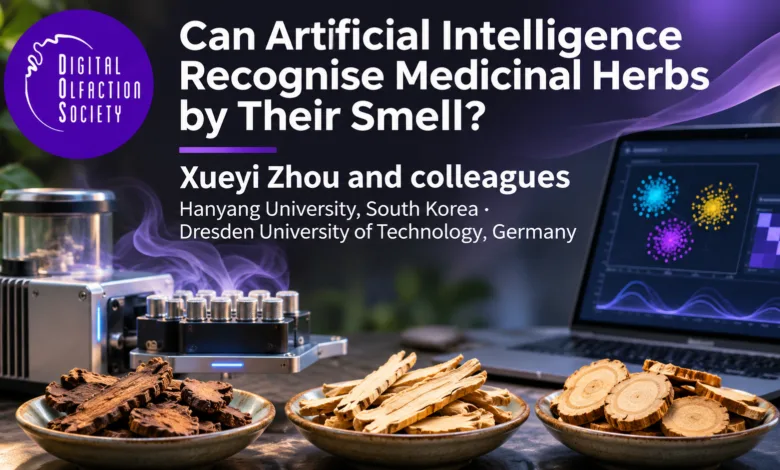
Researchers in South Korea and Germany are combining digital olfaction with machine learning to identify medicinal plants, even when environmental conditions change.
Two medicinal herbs may look remarkably similar while containing different chemical compounds. Distinguishing them accurately is important for authentication, quality control and the safety of products derived from medicinal plants.
But what if their volatile chemical signatures could provide another way to identify them?
Researchers from Hanyang University in South Korea and Dresden University of Technology in Germany are exploring this possibility by combining digital olfaction sensors with artificial intelligence.
Their study examined three traditional Chinese medicinal herbs: Chuanxiong, Danggui and Gancao. Rather than relying on visual characteristics alone, the researchers analysed the volatile compounds released by the plants using a temperature-modulated sensor system.
One of the major challenges in digital olfaction is that sensor responses can change with environmental conditions. A system that performs well in one environment may become less accurate in another.
To address this problem, the team combined two types of information extracted from sensor responses: local variations within individual heating and cooling cycles, and broader patterns describing the overall signal.
Six machine-learning approaches were evaluated. Gradient Boosting delivered the strongest overall performance across the environmental conditions tested.
Classification accuracy ranged from 63.5% to 100% when local and global features were combined, demonstrating promising performance but also highlighting differences between experimental conditions.
The findings suggest that integrating multiple dimensions of sensor information may help improve the adaptability of digital olfaction systems.
While further testing with larger and more diverse plant collections will be important, this research illustrates how artificial intelligence could support new approaches to authentication and quality control.
At Digital Olfaction 2026, the study highlights an emerging direction: transforming invisible chemical signatures into useful information for product identification and quality assessment.
Research: Xueyi Zhou and colleagues — Hanyang University, South Korea; Dresden University of Technology, Germany.
Digital Olfaction Society 2026 | Tokyo, Japan | December 9–10, 2026

