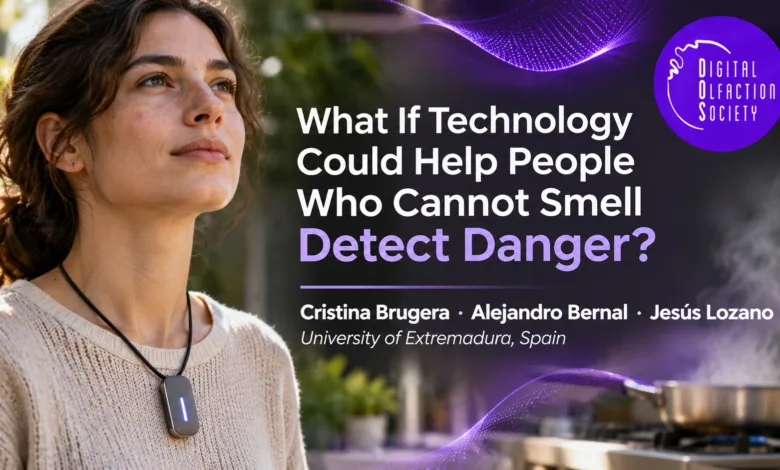
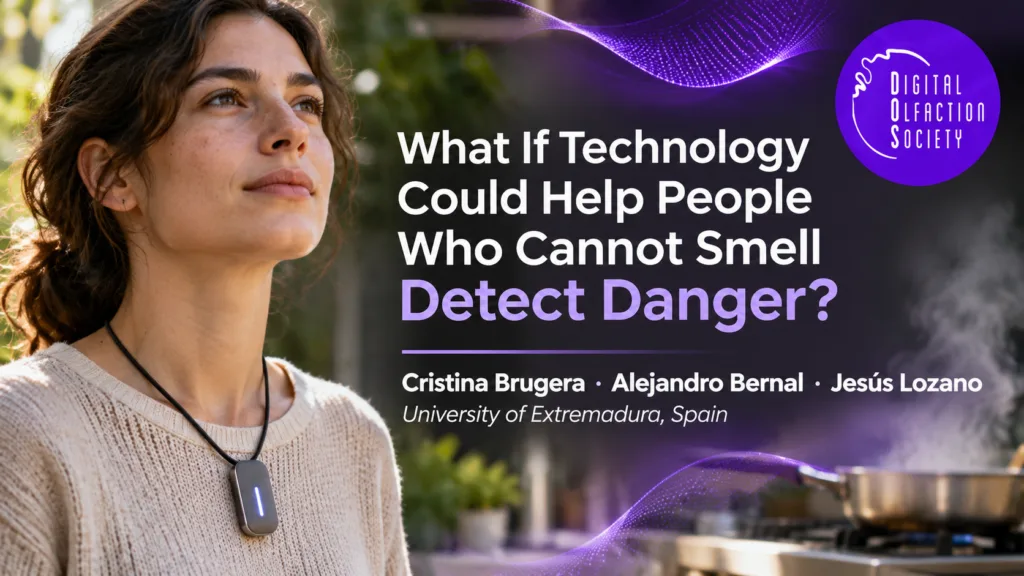
What If Technology Could Help People Who Cannot Smell Detect Danger?
From spoiled food to gas leaks, researchers are developing wearable digital olfaction devices that could help people living with smell loss navigate everyday risks.
For most of us, smell is an invisible safety system. It warns us when food has spoiled, when something is burning or when a potentially dangerous substance is present in our environment. But what happens when that warning system disappears?
Anosmia, the loss of the sense of smell, can affect much more than the enjoyment of food or fragrances. It can also compromise everyday safety, particularly when individuals cannot detect hazardous odours.
At the University of Extremadura in Spain, Cristina Brugera, Alejandro Bernal and Jesús Lozano are exploring a technological response to this challenge. Their research focuses on wearable digital olfaction devices designed to detect environmental odours and potentially alert users to risks they cannot perceive themselves.
The team is investigating several wearable formats, including pendants, rings and watches. An initial pendant prototype combines gas sensors, wireless communication and a smartphone application.
To evaluate the approach, researchers monitored meat and fish over five days of refrigerated storage. Their system identified differences between fresh and older samples, although distinguishing intermediate stages of spoilage remains challenging.
The research is still at an early stage. Larger validation studies, improvements in sensor stability and testing with people living with anosmia will be necessary before these technologies can become reliable everyday aids.
Nevertheless, the direction is significant. Digital olfaction may eventually extend beyond industrial sensing and environmental monitoring to support people whose biological sense of smell is impaired.
At Digital Olfaction 2026 in Tokyo, this research opens a broader question: could artificial smell detection become a new form of assistive technology?
Research: Cristina Brugera, Alejandro Bernal and Jesús Lozano — University of Extremadura, Spain.
Digital Olfaction Society 2026 | Tokyo, Japan | December 9–10, 2026