What If Machines Could Read the Invisible Shape of a Smell?
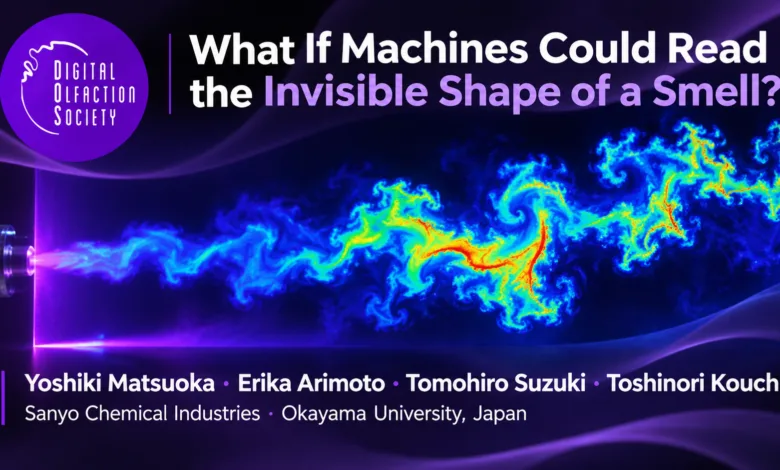
Japanese researchers are exploring the geometry of airborne chemical patterns, opening new possibilities for understanding how odours spread through space.
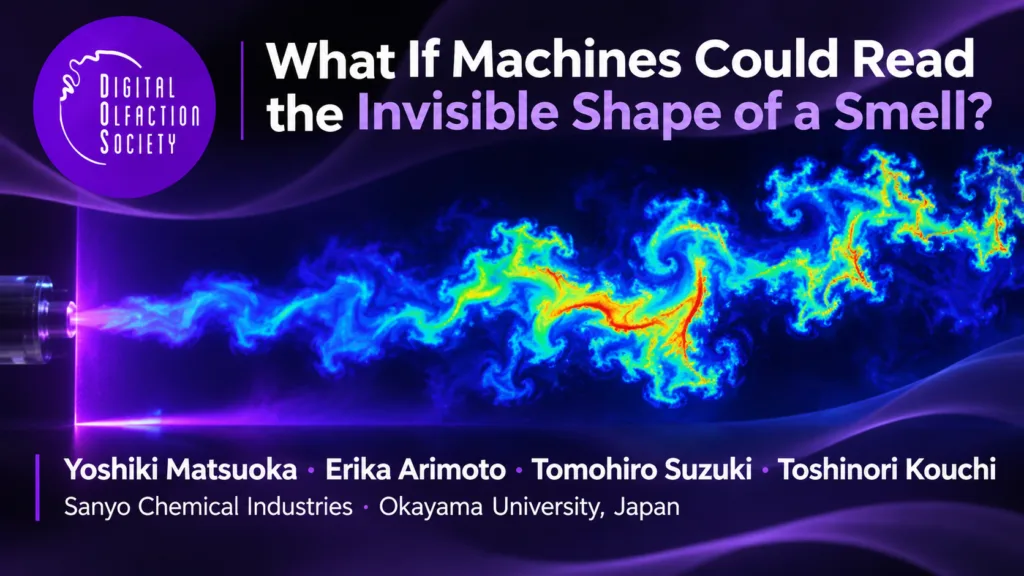
An odour does not travel through the air as a perfectly uniform cloud. Instead, its molecules form complex, irregular patterns influenced by airflow, concentration and the surrounding environment.
For humans, these invisible movements are difficult to observe. Yet understanding them could be important for technologies designed to locate chemical sources, map environmental gases or guide autonomous sensing systems.
Researchers from Sanyo Chemical Industries and Okayama University in Japan are investigating whether mathematical properties of these patterns can provide useful information for digital olfaction.
Their study focuses on acetone released into a controlled airflow. Using laser-induced fluorescence imaging, the scientists visualised two-dimensional concentration fields and examined the shapes formed by regions containing similar acetone concentrations.
They then applied a mathematical approach based on fractal dimensions to characterise the complexity of these shapes.
An interesting observation emerged: the estimated fractal dimensions varied by no more than approximately ±0.05 across the airflow speeds and source concentrations investigated.
This suggests that certain geometric characteristics of chemical distributions may remain relatively stable even when experimental conditions change.
The results are preliminary. Further experiments with additional compounds and odour-free controls are needed to establish whether these measurements could help detect or identify specific chemical substances.
Nevertheless, the research points toward a different way of approaching digital olfaction.
Rather than analysing only the concentration or chemical identity of a substance, future systems might also extract useful information from the spatial organisation of airborne molecules.
Such information could potentially complement conventional chemical sensors in robotic gas mapping and source localisation.
At Digital Olfaction 2026 in Tokyo, this work introduces a fascinating scientific question: can understanding the geometry of invisible chemical patterns help machines interpret their environment?
Research: Yoshiki Matsuoka, Erika Arimoto, Tomohiro Suzuki and Toshinori Kouchi — Sanyo Chemical Industries and Okayama University, Japan.
Digital Olfaction Society 2026 | Tokyo, Japan | December 9–10, 2026